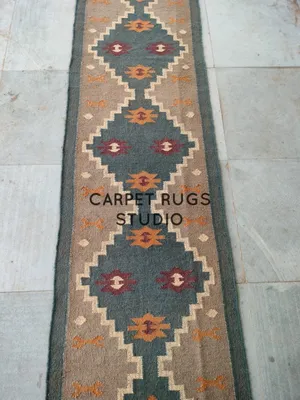


Vintage Runner Rug Long Area Gallery Dhurrie Rugs Handwoven Wool And Jute Kilims Runner Rug Jute Rug Wool Rugs

- Material - woollen , Jute
- Color - Multicolour
- Dimensions - Custom
- Care Instructions - Handwash , spot cleaning recommended with mild detergent
- Features - Flatweae
- Package Includes - Rug
- Origin - Rajasthan


The wool jute rug is made in finest quality of wool and jute material in a ratio of 3:1. These have fastness of color. You can wash it by hand. This is suitable for the high traffic area. Due to two-color, wool and jute material, It’s hide the stain and dust. This is very ideal for those who have pets or Baby. Here find the best contemporary design wool jute dhurrie. This is perfect for the any type of home decor due to the vintage look.
How is a carpet made?
A carpet serves as a textile floor covering and can be seen in almost all Asian homes. European nations also are fascinated by their beauty and thus hand-knotted carpets are in great demand all over the world. A carpet typically consists of an upper layer of fabric and backing attached to it. Carpets can be made in any color by using dyed fibers. Different types of motifs and patterns are fabricated or embroidered on the fabric to beautify the floor. Indian craftsmen make carpets in such a way that every piece bears designs with attention to detail. Bright colors and high-quality fabric are used for their production.
Hand-knotted carpets are made using different types of techniques such as the Turkish knot (symmetrical), Persian knot (asymmetrical), Jufti Knot (tied around four warps instead of two), or Spanish knot (solo warp symmetrical). Common materials used in the making of the finest carpets are cotton, silk, wool, and jute.
1. Wool collection and processing-
This is the step in the carpet-making process in which the best quality raw wool is imported or bought from the market. It is then cleaned and any unwanted particles are removed by washing it thoroughly. Now the clean wool is dried in the sun for two to three days.
2. Woolen yarn spinning-
Spinning involves a process called carding which is either done on carding rollers run by hand or with the help of a carding brush. This wool is now spun into yarn by spinning it on a spinning wheel, also called a charkha. The thickness of the yarn depends on the type and quality of the carpet to be made.
3. Dyeing yarn-
After the yarn is obtained, it is then dyed into different colors as per the requirement. The dyed yarn is now allowed to be sun-dried for at least two days.
4. Designing-
Designing a carpet is time-consuming and the most important step. The size, designs/patterns, and colors of the carpet contribute to the overall look of the carpet. The artisan first draws the design on paper and then copies it on graph paper.
5. Weaving (Hand-knotting)-
Weaving involves two important parts; weft (dyed yarn) and warp (reeled yarn). The warp yarn is loaded to the vertical loom and the graph paper containing the carpet sample design is put in front of the weaver. Each weft yarn is knotted to each warp yarn by hand. In this way, the whole carpet is weaved and the desired pattern is obtained.
6. Washing-
The carpet is now sent for washing multiple times with water and cleansing agents to remove dust and dirt from it.
7. Clipping and Binding-
Now any protruding knots and extra threads are cut off using scissors and clippers. Now the craftsmen ensure that all four sides of the carpet and weaves are locked by stitches so that the carpet remains intact and strong.
8. Final washing and drying-
The carpet is again washed and dried for the last time to make it appear absolutely neat and clean, ready to be put for sale.
Handmade carpets are often more expensive than those made by machines. It takes a minimum of six months to complete one carpet and this elaborate process involves around 20 - 25 artisans working at the same time.
Product Description
Material
jute, wool
Ratio-30% jute 70 % Wool
Dimensions
Length: All Custom Size
Care
Spot clean using a damp cloth
Brush for dust and pet hair
Use a mild detergent for stains, testing on a small, inconspicuous area first
Please do not wash your kilim rugs. Consult a local rug company or dry cleaner to have them clean it for you.
NOTE: - COUNTRY SPECIFIC TAXES AND CUSTOM DUTY WILL BE PAID BY BUYER
Thanks For Visiting Our ShopThe wool jute rug is made in finest quality of wool and jute material in a ratio of 3:1. These have fastness of color. You can wash it by hand. This is suitable for the high traffic area. Due to two-color, wool and jute material, It’s hide the stain and dust. This is very ideal for those who have pets or Baby. Here find the best contemporary design wool jute dhurrie. This is perfect for the any type of home decor due to the vintage look.
How is a carpet made?
A carpet serves as a textile floor covering and can be seen in almost all Asian homes. European nations also are fascinated by their beauty and thus hand-knotted carpets are in great demand all over the world. A carpet typically consists of an upper layer of fabric and backing attached to it. Carpets can be made in any color by using dyed fibers. Different types of motifs and patterns are fabricated or embroidered on the fabric to beautify the floor. Indian craftsmen make carpets in such a way that every piece bears designs with attention to detail. Bright colors and high-quality fabric are used for their production.
Hand-knotted carpets are made using different types of techniques such as the Turkish knot (symmetrical), Persian knot (asymmetrical), Jufti Knot (tied around four warps instead of two), or Spanish knot (solo warp symmetrical). Common materials used in the making of the finest carpets are cotton, silk, wool, and jute.
1. Wool collection and processing-
This is the step in the carpet-making process in which the best quality raw wool is imported or bought from the market. It is then cleaned and any unwanted particles are removed by washing it thoroughly. Now the clean wool is dried in the sun for two to three days.
2. Woolen yarn spinning-
Spinning involves a process called carding which is either done on carding rollers run by hand or with the help of a carding brush. This wool is now spun into yarn by spinning it on a spinning wheel, also called a charkha. The thickness of the yarn depends on the type and quality of the carpet to be made.
3. Dyeing yarn-
After the yarn is obtained, it is then dyed into different colors as per the requirement. The dyed yarn is now allowed to be sun-dried for at least two days.
4. Designing-
Designing a carpet is time-consuming and the most important step. The size, designs/patterns, and colors of the carpet contribute to the overall look of the carpet. The artisan first draws the design on paper and then copies it on graph paper.
5. Weaving (Hand-knotting)-
Weaving involves two important parts; weft (dyed yarn) and warp (reeled yarn). The warp yarn is loaded to the vertical loom and the graph paper containing the carpet sample design is put in front of the weaver. Each weft yarn is knotted to each warp yarn by hand. In this way, the whole carpet is weaved and the desired pattern is obtained.
6. Washing-
The carpet is now sent for washing multiple times with water and cleansing agents to remove dust and dirt from it.
7. Clipping and Binding-
Now any protruding knots and extra threads are cut off using scissors and clippers. Now the craftsmen ensure that all four sides of the carpet and weaves are locked by stitches so that the carpet remains intact and strong.
8. Final washing and drying-
The carpet is again washed and dried for the last time to make it appear absolutely neat and clean, ready to be put for sale.
Handmade carpets are often more expensive than those made by machines. It takes a minimum of six months to complete one carpet and this elaborate process involves around 20 - 25 artisans working at the same time.
Product Description
Material
jute, wool
Ratio-30% jute 70 % Wool
Dimensions
Length: All Custom Size
Care
Spot clean using a damp cloth
Brush for dust and pet hair
Use a mild detergent for stains, testing on a small, inconspicuous area first
Please do not wash your kilim rugs. Consult a local rug company or dry cleaner to have them clean it for you.
NOTE: - COUNTRY SPECIFIC TAXES AND CUSTOM DUTY WILL BE PAID BY BUYER
Thanks For Visiting Our Shop
CARPET RUGS STUDIO


Our online store has a collection of KILIM AREA RUGS, BOHO THROW PILLOWS, TABLE RUNNERS, and WALL HANGINGS for every room in